It is the second day of the trip,
and the first night in Karatsu.
I had Saga beef for dinner,
then drinks at a gyoza bar for the second round,
and drinks again at a stand bar for the third.
Now it is time to slowly wrap up the night.
It is not even midnight yet,
but my stamina is already giving up.
As I get older,
my travel style is slowly changing.
The last stop after drinking is always ramen.
I like to fill my stomach with noodles
while soothing my body with a thick tonkotsu broth.
I was about to open Google Maps
and search for a ramen shop,
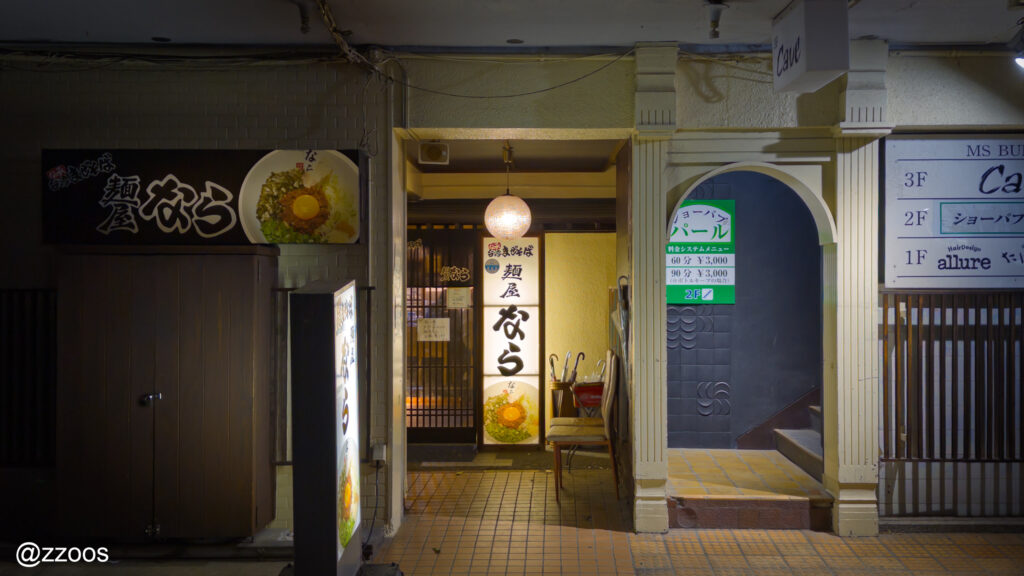
but then I saw a sign that said “Menya (麺屋)”
on the building right next to me
and walked in without thinking.
I had absolutely no prior information about the place.
It turned out to be a shop called
Menya Nara (麺屋なら 本町本店)
Now that I think about it,
there was a huge photo of mazesoba on the sign.
But at the time,
I did not notice that photo at all.
Instead,
I only saw the smallest text on the sign,
the word “Menya (麺屋),”
and that alone made me walk in.
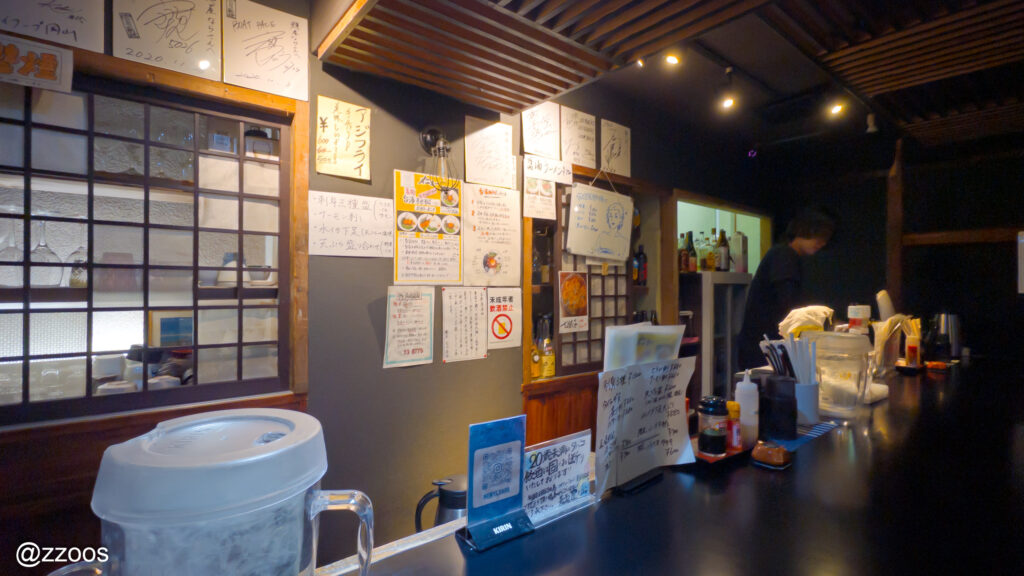
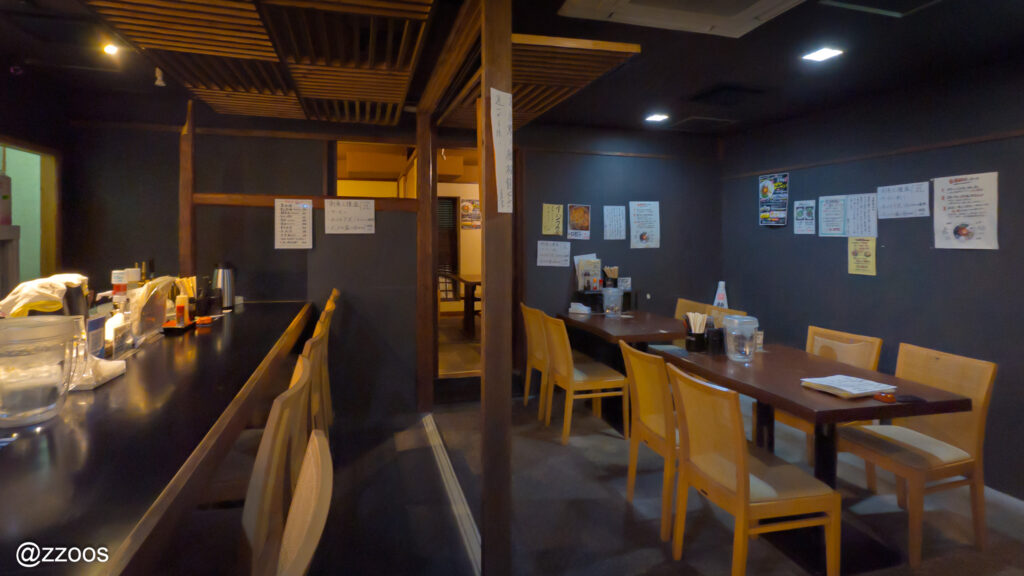
The shop was larger than I expected.
A group of young people had taken over a section
and were laughing and chatting loudly.
It was quite late, and the streets outside were almost empty.
But inside the shop, there were quite a lot of people.
After spending several nights in Karatsu, I noticed something.
There are almost no people on the streets, but the shops themselves are full.
Especially popular places —
as is the case almost everywhere these days —
are difficult to visit without a reservation.
At first,
I thought it was a completely quiet town because there were so few people outside.
But it turned out not to be that quiet after all.
First,
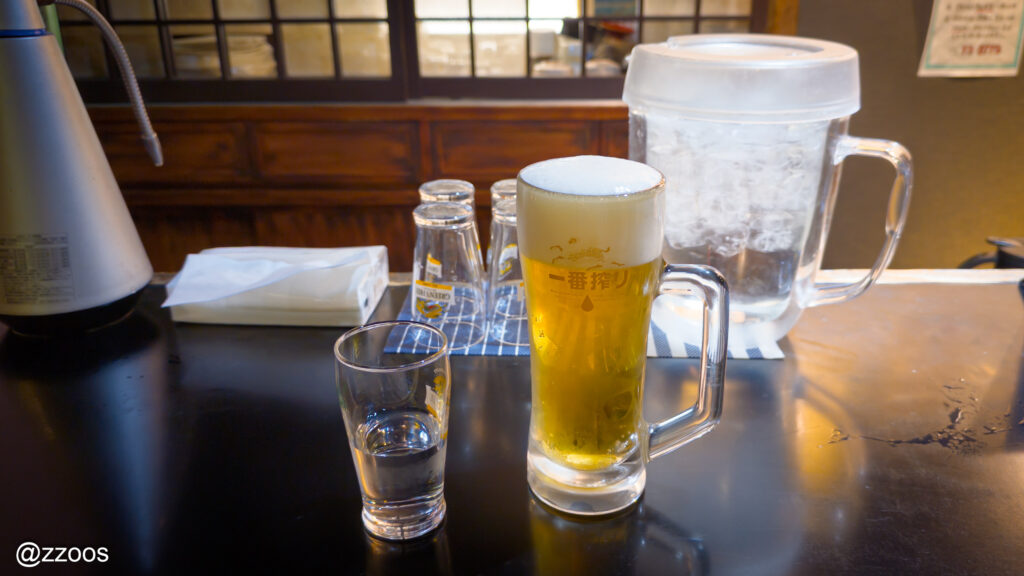
I ordered a glass of ‘nama’ beer
and started reading the menu.
Wait.
This is not a tonkotsu ramen shop?
I had walked in without noticing the large mazesoba photo on the sign.
That explains whyI had not smelled the thick pork broth simmering.
I should have noticed that earlier.
Looking at the menu,
they do serve ramen with soup like shoyu ramen.
But the dish written as the shop’s signature is Taiwan Mazesoba (台湾まぜそば).
There is a ramen called Taiwan Ramen that started in Nagoya.
It is a ramen topped with spicy minced meat over chicken broth.
That spicy minced meat is its defining feature,
and Taiwan Mazesoba is known as a mazesoba dish that uses that same topping.
Apparently, it is not actually a dish from Taiwan.
Since Taiwan Mazesoba is spicy,
I ordered a regular mazesoba that was not spicy.
Even if it was spicy, it probably would not be very spicy for me as a Korean.
But late at night,
I did not want to put unnecessary strain
on my stomach with spicy food.
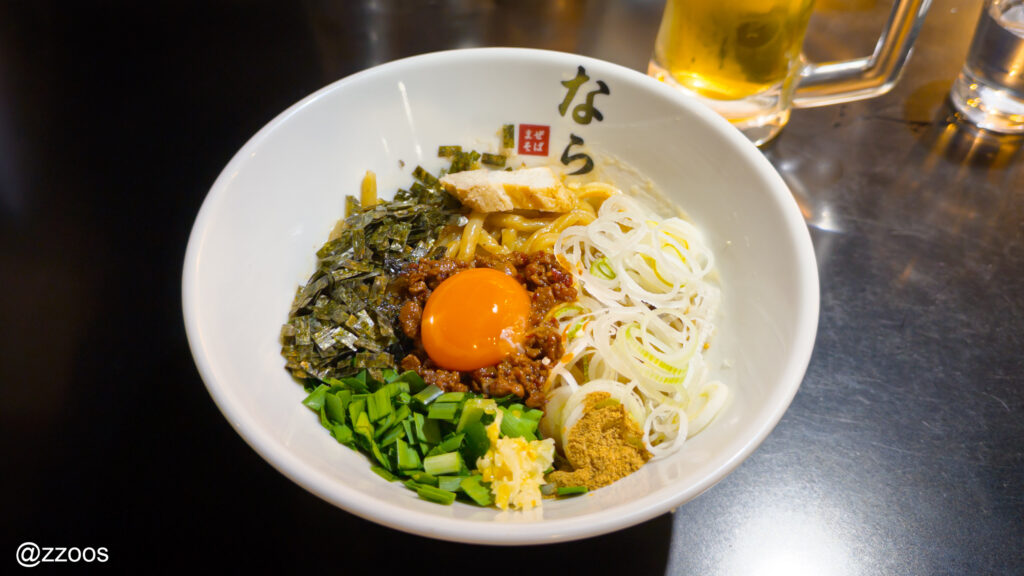
The mazesoba arrived.
On top of thick,
chewy noodles similar to Sanuki udon,
there were already sauce-coated noodles,
and various toppings were placed on top.
Seaweed,
garlic chives,
green onions,
fish powder,
minced garlic,
a small piece of meat,
minced meat sauce,
and an egg yolk.
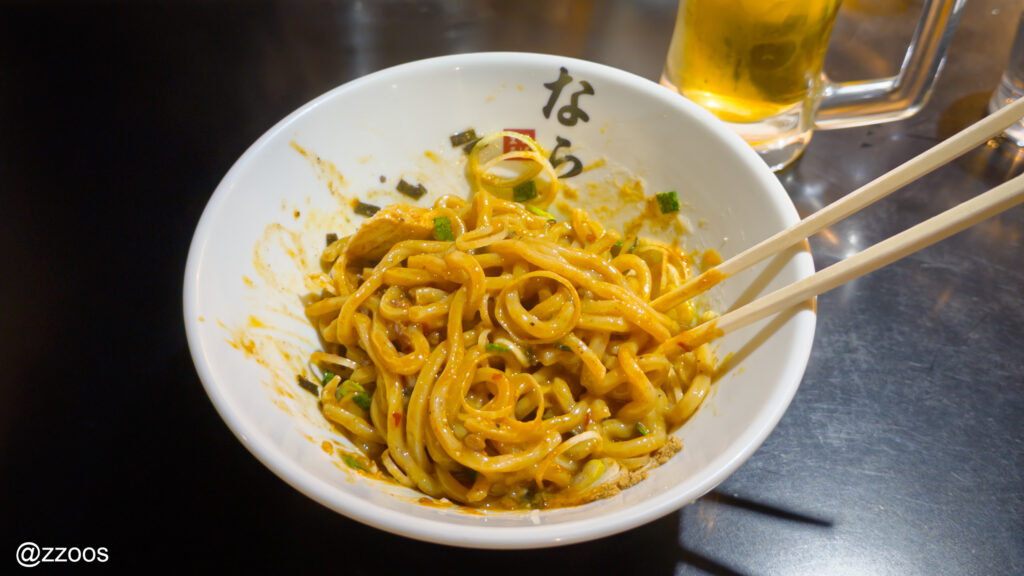
After taking a photo,
I mixed all the toppings into the noodles.
The moment I took the first bite,
the umami exploded.
As I kept eating the thick noodles mixed with the meat sauce,
I suddenly thought the umami reminded me of jjajangmyeon.
Come to think of it, some people explain that the position of “ramen” in Japan
is similar to the role of “jjajangmyeon” in Korea.
In Korea and Japan, we call them “Chinese food,”
but in China that exact dish does not really exist.
And overseas, it is often considered a “Korean food” or “Japanese food.”
In that sense,
there are some similarities.
To be honest,
mazesoba is not something I have eaten very often.
So I cannot really compare it
with other mazesoba dishes.
I have no reference point at all
to judge whether this level of mazesoba
is something common,
or if this shop simply does it exceptionally well.
In any case,
perhaps the late-night drinking
gave it an extra boost of deliciousness,
but I simply enjoyed it.
This was the story of
Menya Nara,
a mazesoba shop
I happened to walk into by chance.