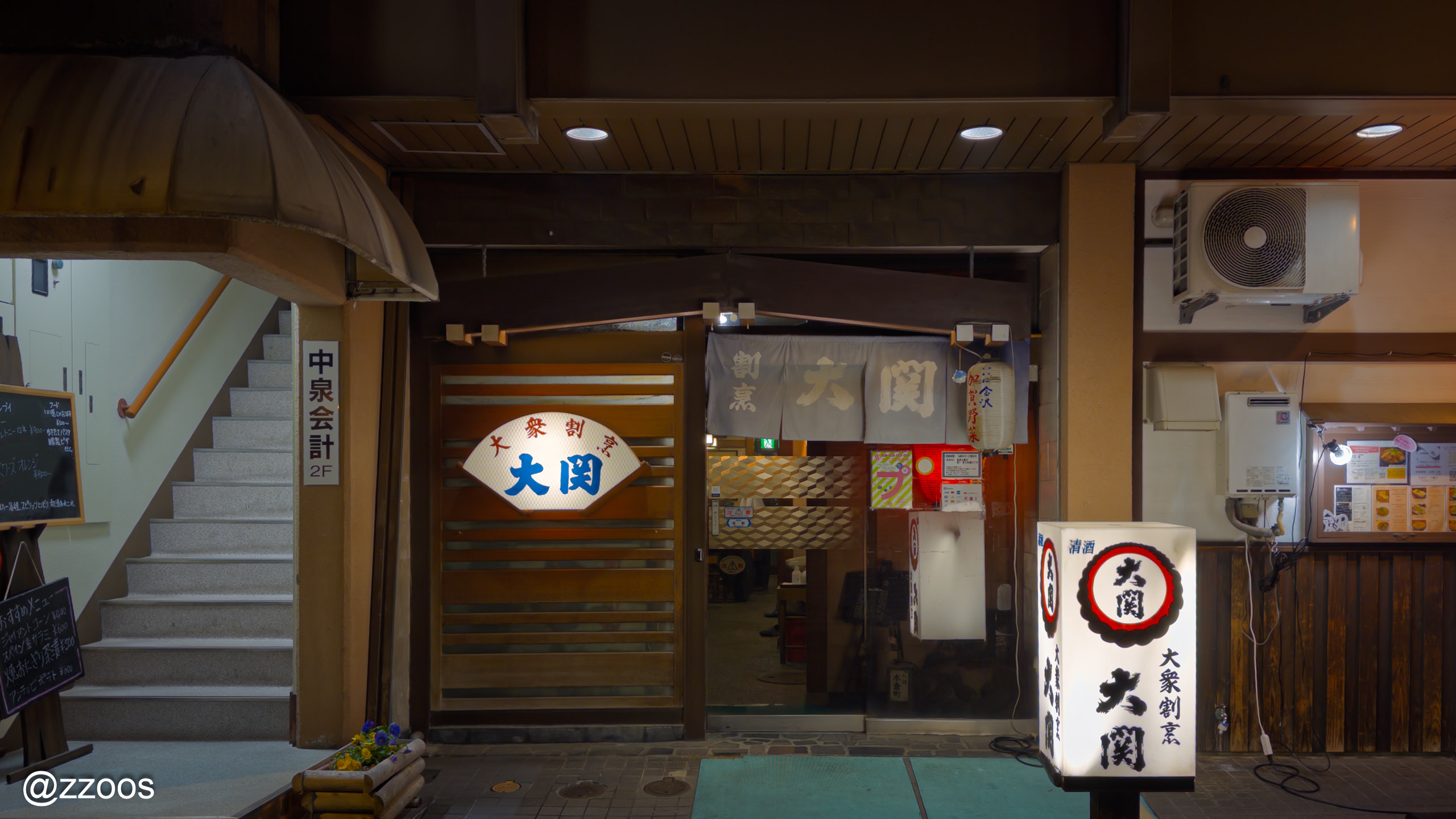
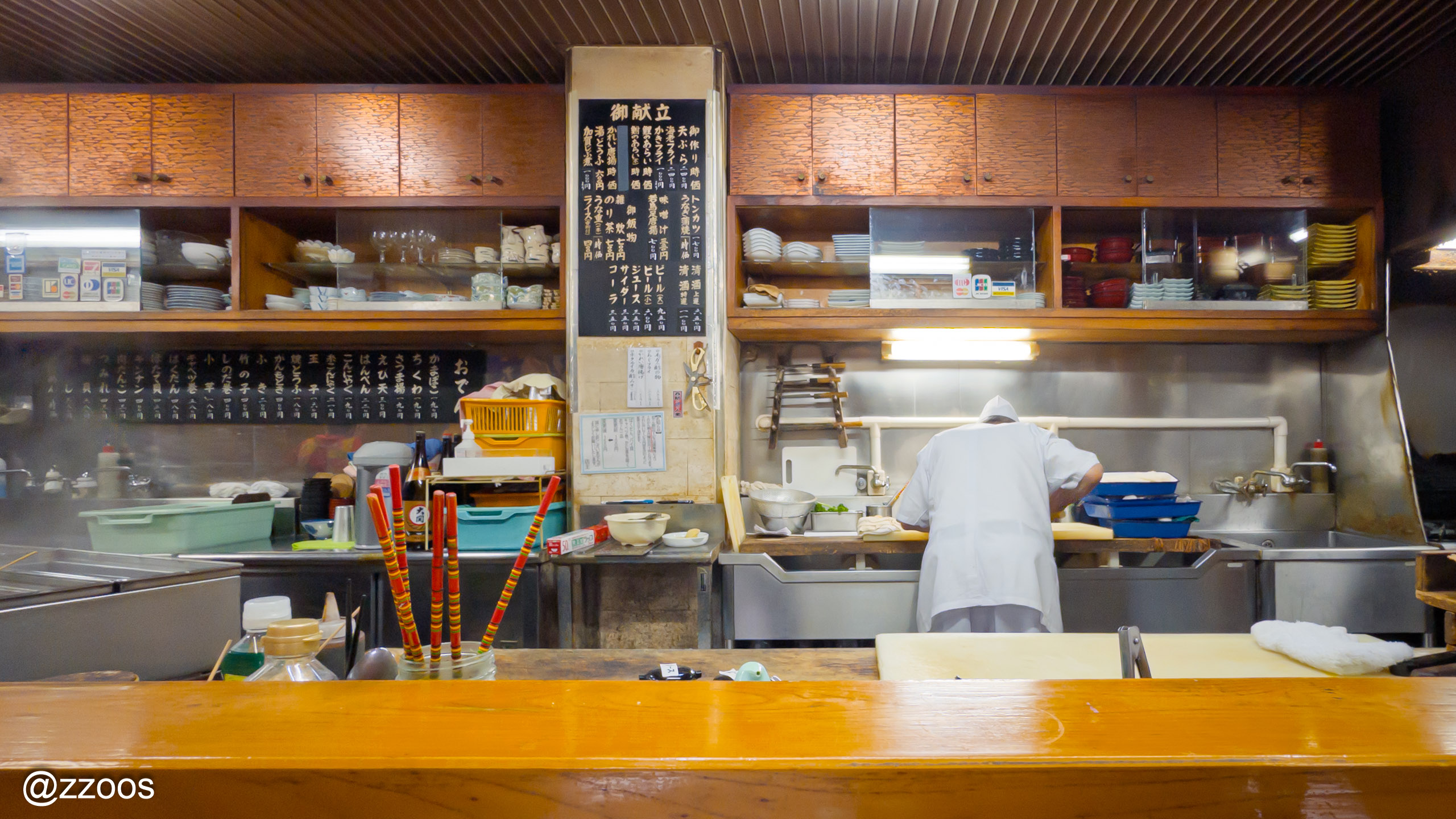
On the last day of a six-night, seven-day trip, it’s finally my last dinner in Kanazawa. I wanted to close out the trip with a good meal. So I came to one of the places Ilmare had recommended a few days back.
It’s Ozeki (大関), right at the entrance of Kiguramachi (木倉町).
The sign reads taishu kappo (大衆割烹).
A kappo is a little different from an izakaya (居酒屋). It’s a place that focuses on handmade dishes. An izakaya, by comparison, offers simpler food along with a relaxed space, while a sakaba (酒場) is centered on drink rather than food or snacks.
So a kappo tends to run pricier than an izakaya or a sakaba, but with taishu (大衆) tacked on, you can expect it won’t be all that expensive. In fact, it’s in about the same price range as a cheap izakaya.
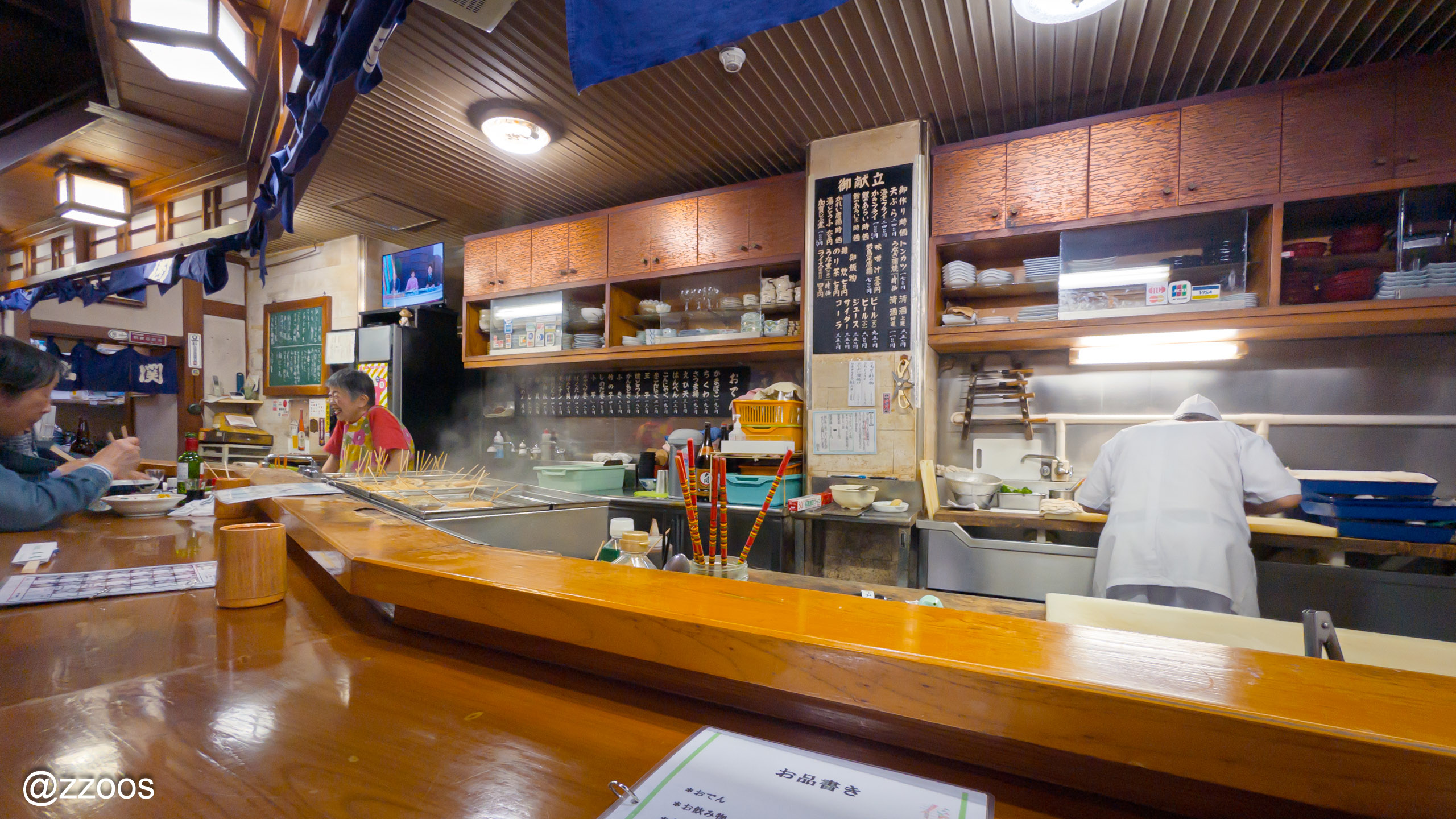
The place is pretty spacious. The counter alone seats about ten. Behind it, out of frame, there are several rooms where you take off your shoes and sit up on the floor.
I arrived around 6 p.m., and it was still quiet. But after a little while it filled right up with customers — it’s a popular spot.
Watching an elderly couple who seemed to be the owners working alongside a middle-aged man who looked like their son, I could guess why. There seemed to be a lot of regulars.
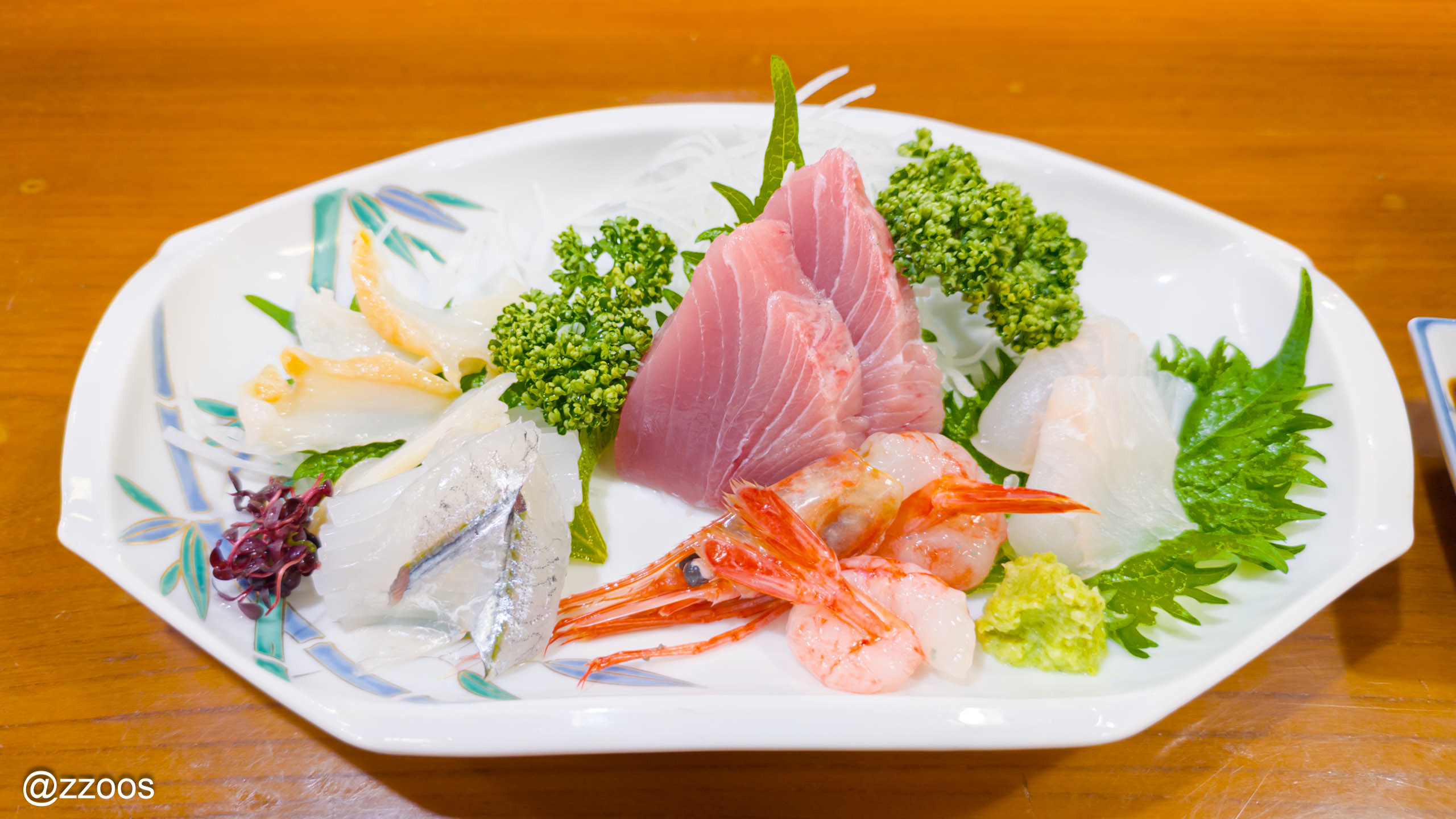
My first order was the assorted sashimi and a shochu soda.
The big pink cut was meji-maguro (メジマグロ), young bluefin tuna. The pretty shrimp below it is amaebi (甘エビ).
The white-fleshed fish on the right looks like hirame (平目), flounder. You don’t often eat flounder in Japan, though.
Top left looks like some kind of shellfish, and below it is sayori (サヨリ), halfbeak. There was also squid tucked under the sayori, hard to see, but I’m not sure what kind.
Overall it was ordinary but clean sashimi. Kanazawa’s famous signature seafood was missing from the lineup, but in exchange it was cheap, which I liked. It was also nice to have meji-maguro again after a long time.
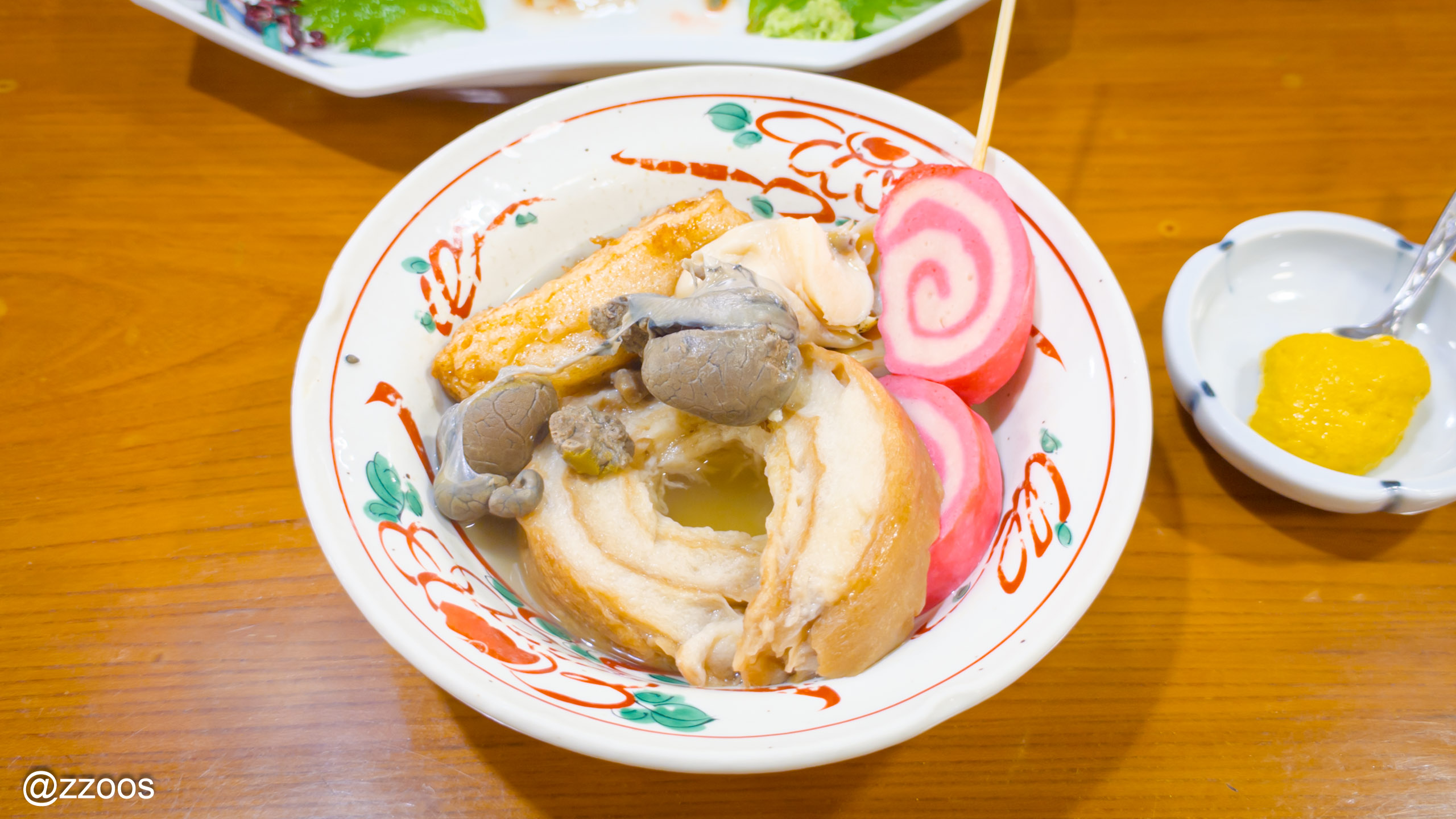
Looking at the menu, there were so many kinds of oden. So this place’s specialty must be Kanazawa oden! — and I ordered a few kinds.
First, the round oden in the middle is kurumafu (くるまふ), the oden that represents Kanazawa.
They say it’s made from wheat gluten shaped into a ring; it soaks up plenty of broth and has a chewy bite, so it was unusual and delicious.
I also ordered kamaboko (かまぼこ), the kind of Japanese oden we see all the time.
In particular, the red-and-white swirling kamaboko you can see in the photo is called akamaki (赤巻). This shape of kamaboko is also said to be one of Kanazawa oden’s signatures.
And I ordered one gobo-ten (ごぼう天) too — ordinary, but something I like. It’s burdock wrapped in fish paste and fried.
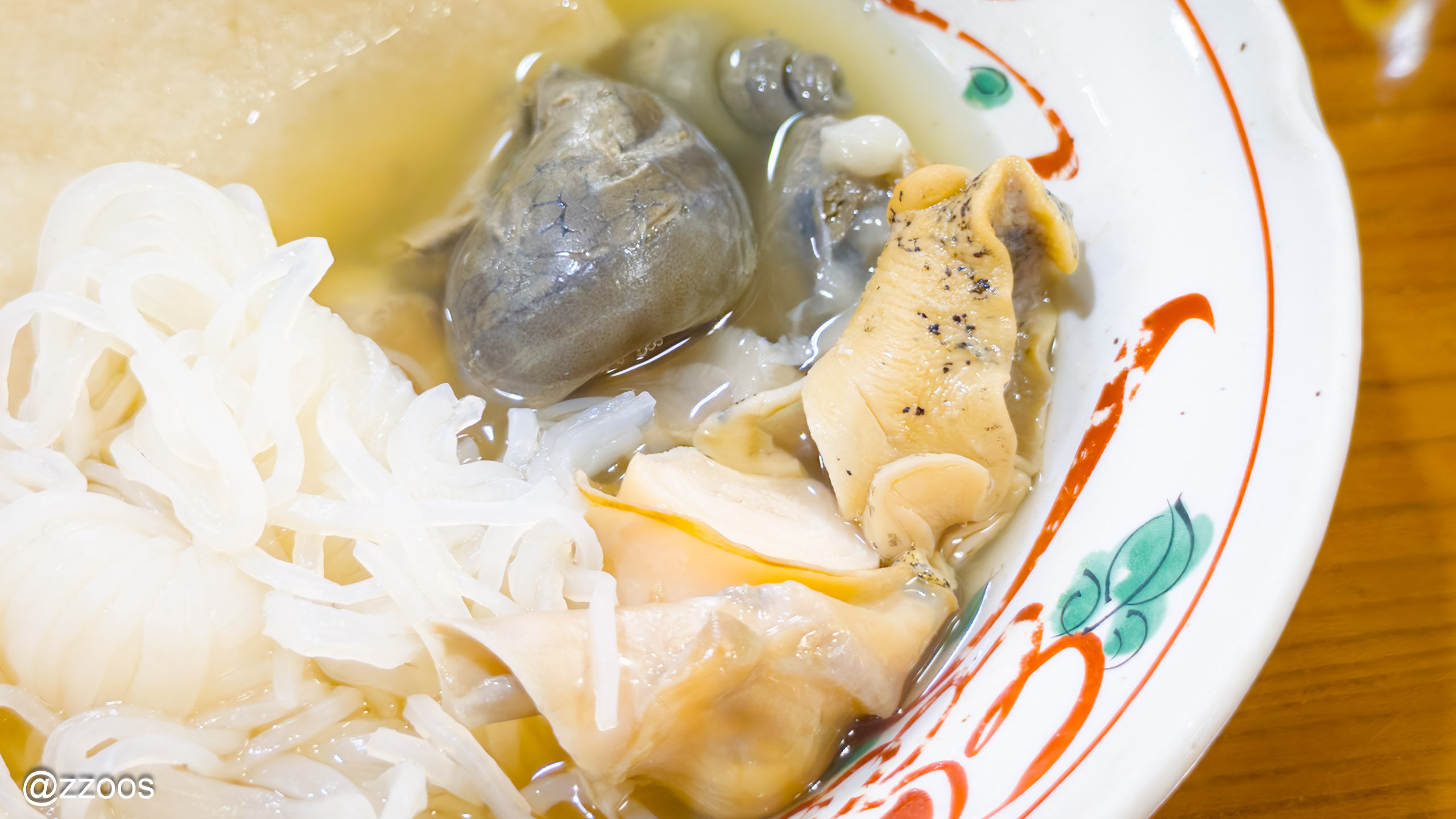
And last, the one thing I ate here — no, the most memorable thing I ate on this whole trip — the baigai (ばいがい) oden.
Baigai is what we’d call a whelk. Baigai oden means this simmered together in the oden broth.
They simmer a whelk the size of an adult’s fist well in the broth, and only when an order comes in do they take it out and carefully crack the shell with a hammer so the innards aren’t damaged.
That way they serve up the whelk’s innards completely, all of it, without a single bit damaged.
I happen to love the innards of shellfish like turban shells and whelks. I love that faintly bitter taste.
This oden, prepared so I could catch and truly savor every bit of that flavor without missing any, was the best dish of this whole trip.
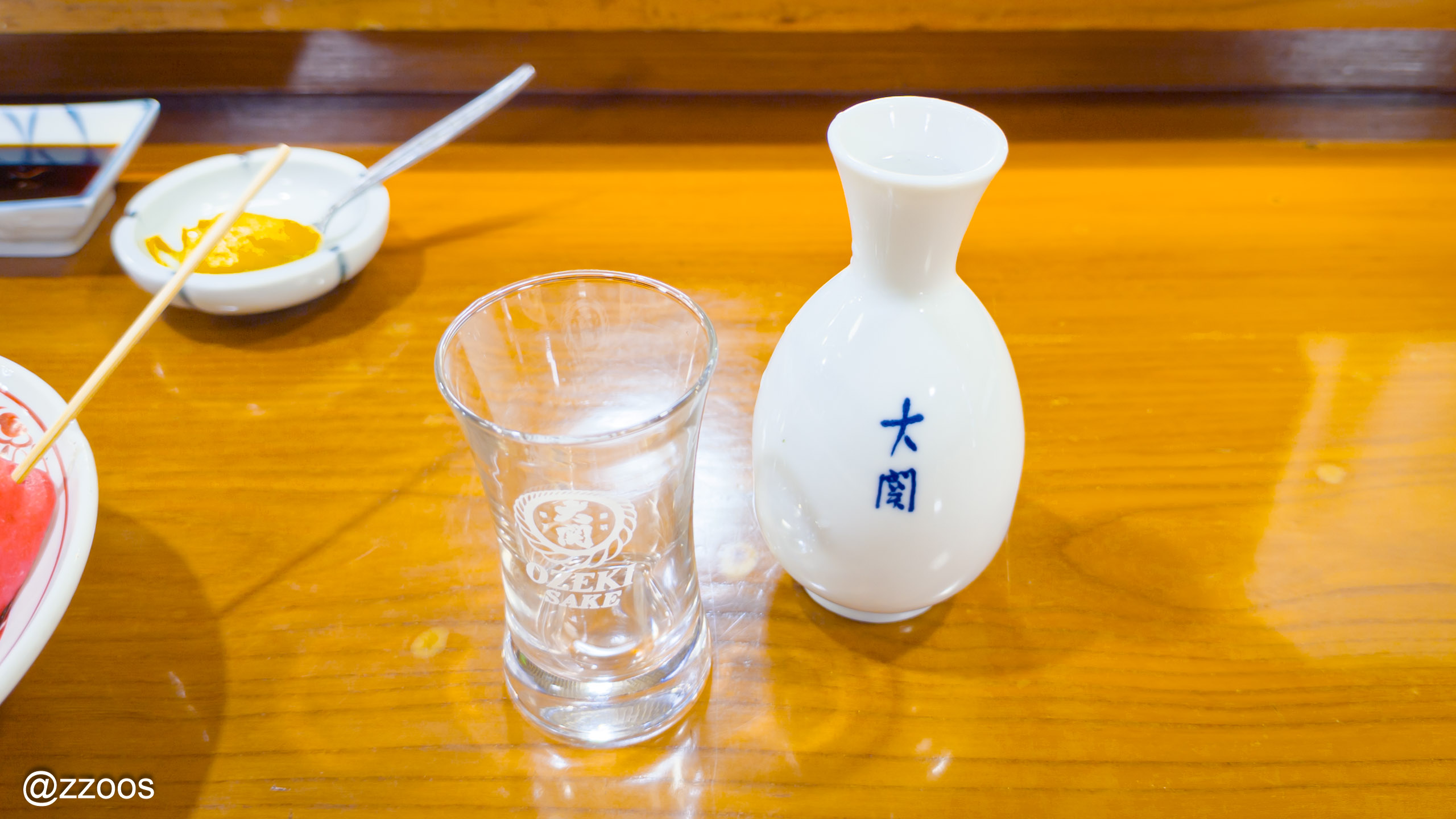
I liked the oden so much that I ordered a nihonshu. Looking at the shop’s wall, it was lined full with a nihonshu bearing the same name as the restaurant.
Did they have it specially made for the shop? — I looked into it a bit, and this nihonshu called Ozeki (大関) turned out to be one of the fairly popular nihonshu in Japan. Since there happened to be a nihonshu with the same name as the shop, people must drink a lot of it.
So I had a go of it myself.
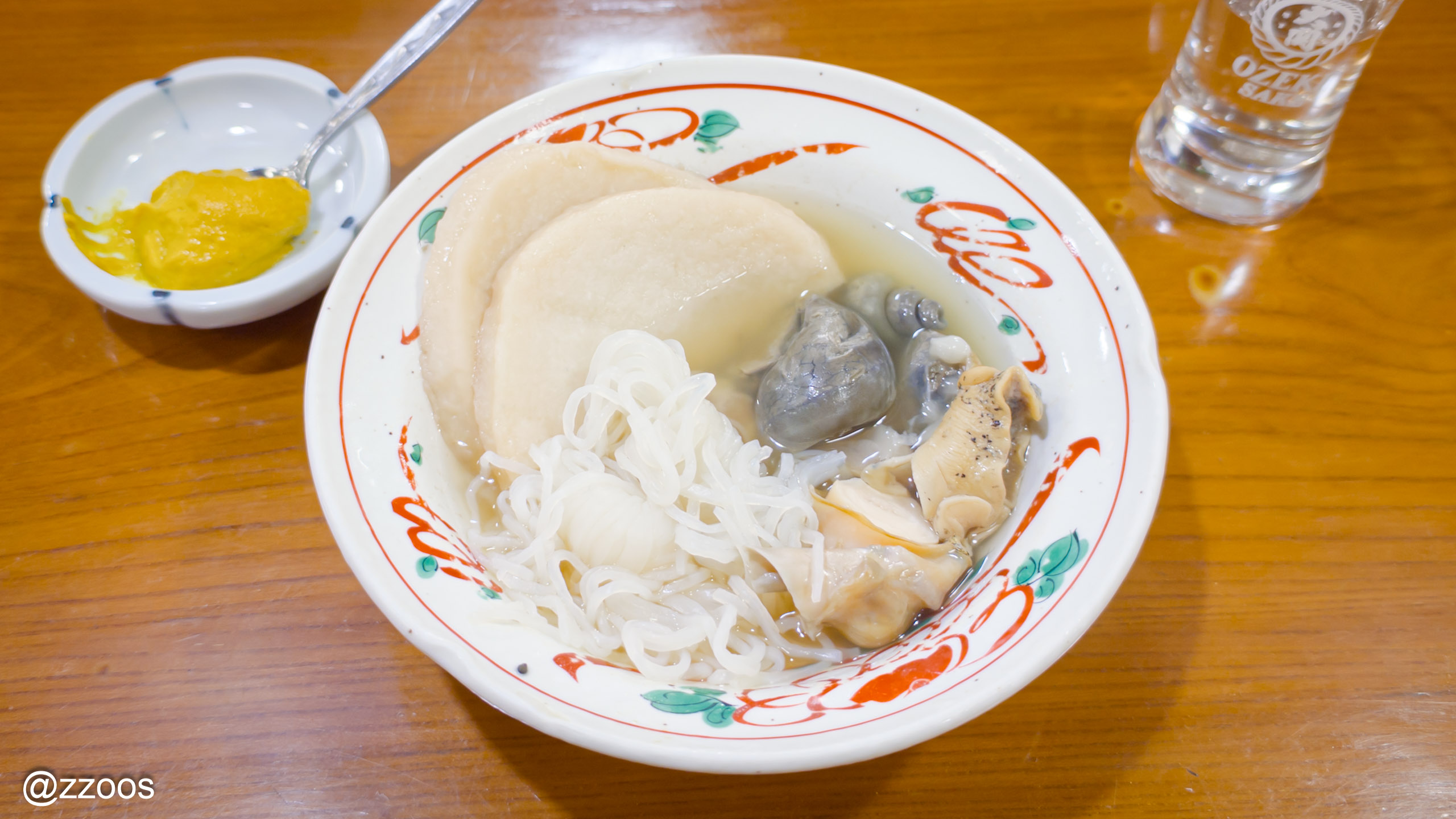
Since I liked the oden, I try ordering a few more kinds.
Well, actually — while placing a repeat order because I wanted more baigai, ordering just one kind felt a bit odd, so I ordered hanpen (はんぺん) and ito-konnyaku (糸こんにゃく), shirataki, along with it.
Maybe that’s why the hanpen and the shirataki just tasted ordinary.
But the baigai — ah, of course — is delicious even the second time.
The baigai is 680 yen, about three times pricier than the other oden. But to eat this, I feel completely willing to pay that much. Of course, this reflects a whole lot of purely personal taste, mind you.
After filling up somewhat, I hurried out of the shop. There are lots of places to go tonight.
I stopped by Ilmare to say I was heading back now.
The Ilmare family said they’d be traveling to Korea before long too. They told me to be sure to get in touch when they come, and we exchanged contact info.
I dropped by Hiroko again as well.
While laughing and chatting and drinking with a lot of people, I met a fun guy, and we moved over to a place called Otsuyuya (おつゆや) to drink some more. This place was a lot of fun too.
Drinking like that until dawn, I came back to the hotel full of reluctance to leave.
Tomorrow I have to start getting ready from early morning to head back to Korea.